MLB Live Betting: Spotting Slow Lines Between Innings
 Available in US
The pause that pays
I had a slow Sunday a few summers back where I made more on a single afternoon’s between-innings betting than I’d made on the whole previous week’s pre-game card. Nothing exotic – just patient watching of a few games and acting on lines that hadn’t quite caught up to what was happening on the field. That afternoon convinced me that live MLB betting isn’t a separate skill from pre-game; it’s the same skill applied to a different timing window where the bookmaker’s pricing engine has gaps you can read.
Football and basketball move too fast for most retail bettors to outpace the bookmaker’s live algorithms. Baseball is different. The natural breaks between innings, the pitching changes, the slow accumulation of pitch counts – all of these create predictable moments where the line has to recalibrate, and the recalibration isn’t always immediate. That gap, repeated across nine innings, is where the live edges live.
Why baseball’s pace is the live bettor’s friend
Average MLB game time in 2025 was 2 hours 38 minutes – the third consecutive season at or below 2:40, the first such streak in 40 years. That sounds like bad news for live betting, since faster games leave less time to make decisions. In practice, the opposite is true. The pitch clock has standardised the rhythm of MLB games in a way that makes the breaks between innings sharper and more predictable.
The structural difference between baseball and other live markets is the discrete nature of every event. Each pitch is its own complete event with a knowable outcome. Each at-bat resolves cleanly. Each inning is a fixed unit of three outs followed by a standardised break. That structure means the bookmaker’s pricing model has to update at known points rather than continuously, and the update isn’t always smooth.
Compare that to football, where the line has to adjust continuously to attacking momentum, possession shifts, and the constantly changing time remaining. The bookmaker’s continuous algorithm is well-tuned for that. Baseball’s discrete rhythm gives the patient bettor moments to think, check the data, and place a thoughtful bet inside a finite window before the line moves.
Only three nine-inning MLB games in 2025 lasted 3:30 or longer, compared with 391 such games in 2021. The pace change is real and the rhythm is more predictable than ever. For live betting, that’s the foundation of every edge that follows.
Inning breaks: the most reliable window
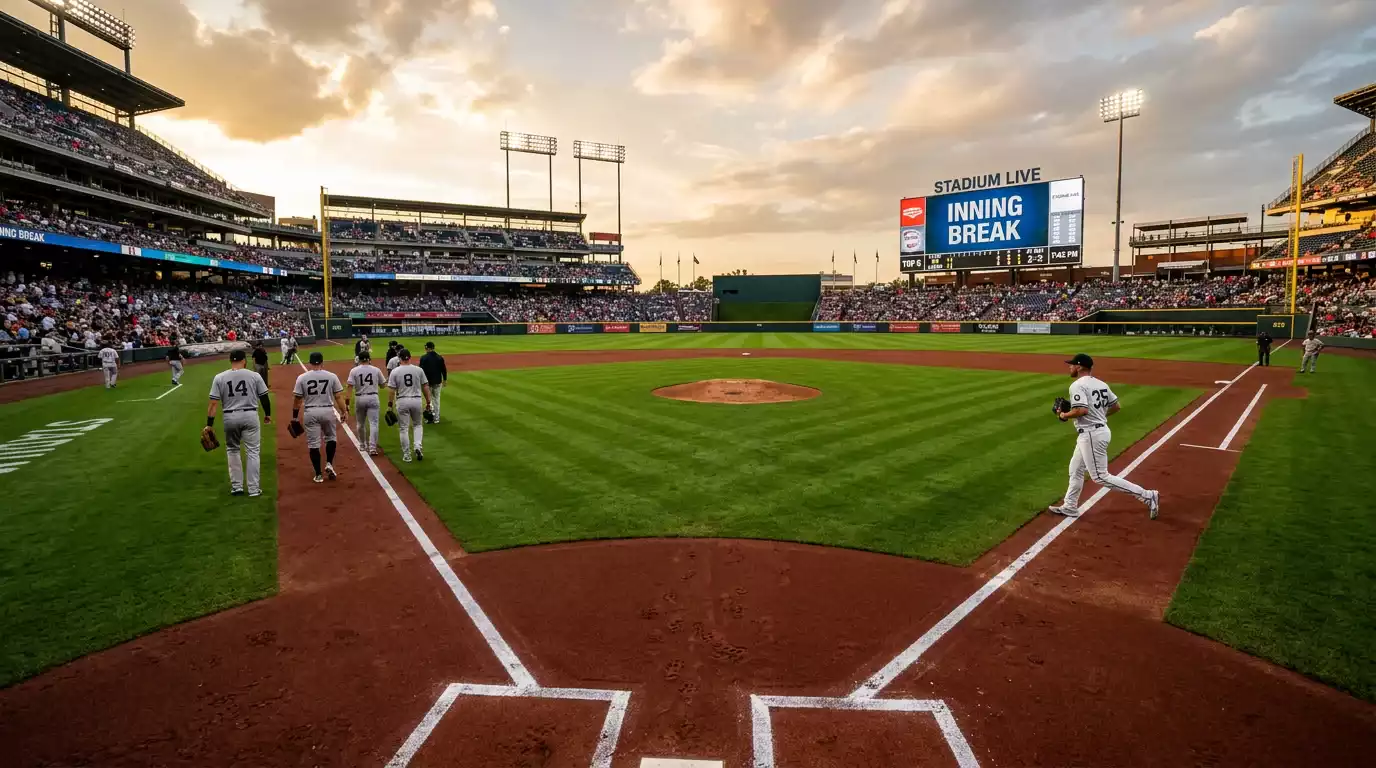
The two-and-a-half-minute window between innings is the single most exploitable structural moment in live MLB betting. The book knows the score has changed, knows the pitcher has thrown more pitches, and knows the lineup has rotated – but the line doesn’t necessarily reflect all three changes immediately, and during the break new information arrives that the line has to absorb.
What I watch for during the break:
The pitcher’s pitch count and visible fatigue indicators. A starter sitting on 78 pitches through five with a clean velocity reading is in a different position to one sitting on 92 pitches through five with a 1 mph velocity drop. The first is set up to pitch deep into the game; the second is on the manager’s hook radar. The live total moves on this read, but often slowly.
The lineup turn coming in the next inning. If the bottom of the order has just made the third out and the top is up to start the next half-inning, the offensive expectation for that half-inning is structurally elevated – and the live line on team total or run total in that inning may not have repriced.
The bullpen warming. Often visible on the broadcast feed. If a leverage reliever starts warming during the seventh-inning break, that’s a strong signal the manager is prepared to pull the starter early. The live line should adjust; sometimes it doesn’t until the actual change is announced.
The trick is acting inside the window. If you wait until first pitch of the next inning, the line has usually corrected. If you act in the first thirty seconds of the break, you’re often betting against a line built off the previous inning’s information rather than the current state of the game.
Pitching changes as a separate signal
When a pitcher is removed mid-inning, the live line jumps. The book repriceses based on the new pitcher’s quality versus the situation, and the move can be sharp – sometimes 15 to 20 cents on the moneyline, more on team totals. The question for the live bettor is whether the move is too far, too short, or about right.
The systematic mistake I see books make: overweighting the new reliever’s surface stats and underweighting the situation. A high-leverage reliever brought in mid-inning with two on and one out is in a much harder spot than his ERA suggests. His season ERA was earned mostly with clean innings starts, not with inherited runners on second and third. The live line based on his ERA underrates the difficulty of the spot. Backing the offence in this scenario at a freshly cut number is often a positive-EV bet.
The opposite happens with elite closers brought in for non-save situations. A closer pitching the seventh in a tied game is genuinely operating below his peak leverage and his peak focus. The line treats him like the closer he is in the ninth. The lineup he’s facing might have a real advantage that the line underprices.
The other pitching-change signal is the platoon-driven swap. A right-handed starter being lifted for a left-handed specialist against three left-handed bats coming up isn’t a generic line move – it’s a specific matchup advantage that should sharpen the price more than the season ERA gap suggests. If the line moves only on the ERA gap and not on the matchup, that’s an angle.
Bookmaker latency: where the genuine windows hide
Not every UK book runs the same live pricing engine. The flagship operators have tight, fast models that incorporate Statcast data feeds and update lines in near-real-time. Smaller operators run lagging models that often trail the consensus by several seconds, sometimes longer between innings or after major events.
The latency window is where the most reliable live edges sit. If a home run lands in the top of the fourth and one operator has updated the team total line within fifteen seconds while another hasn’t moved it for 90 seconds, that’s a window – narrow but real – to take the lagging line at the old price.
This isn’t theoretical. I run two betting accounts open during games I’m watching specifically to take advantage of latency gaps between operators. The half-cent that doesn’t matter pre-game can matter materially live, because the line will catch up within minutes and the window closes. If you’re going to live bet seriously, multiple-account workflow is part of the discipline.
The flagship operators are also the safest places for sharp live action because their limits are higher and their pricing is honest. Smaller books with lagging engines sometimes restrict accounts that find their latency too consistently. The professional approach is to spread action and not lean exclusively on the laggards, even when they offer the best lines.
The traps that ruin live MLB returns
Live betting is fast and emotional, and the bookmaker’s overall hold is often slightly higher live than pre-game to account for that. Three traps come up consistently enough to mention.
Chasing the live narrative. A team that just scored three runs feels like they’ll keep scoring. The data says they probably won’t – runs are not autocorrelated across innings in the way our brains want them to be. Acting on the recency narrative is a structural loser.
Betting between every pitch. The pitch-by-pitch micro markets exist and are heavily juiced. Acting on every pitch turns the game into a slot machine. I treat live MLB as a betting opportunity at most twice per game on the right inputs, not as a continuous gambling experience.
Forgetting your bankroll discipline. Live betting has a way of turning a flat-staked bankroll into a chase-driven one. The same unit-sizing rules apply live as pre-game. If anything, live unit sizes should be tighter to account for higher juice and faster decisions.
The discipline pays off in part because it’s structural – every single live bet should be a calmer, more deliberate decision than its pre-game equivalent, not a faster one. The patient bettor wins live; the impulsive one funds the bookmaker.
Across enough games, the inning-break and pitching-change angles compound into real value. The metric I use to track whether my live betting is genuinely outperforming or just feeling like it does is closing line value. If you want the deeper read on why CLV is the most reliable measure of long-term betting skill, my piece on how to track closing line value in MLB walks through the maths and the workflow.
Is MLB live betting more profitable than pre-game?
Not categorically – but it’s structurally different. Live offers windows of value during inning breaks and pitching changes that pre-game can’t reach, but the average hold is slightly higher live and the pace can pull bettors into bad decisions. The honest answer is that live and pre-game are different skills with different edges. Bettors who treat live as a separate, deliberate workflow can outperform pre-game returns. Bettors who treat it as fast pre-game generally underperform.
When do live MLB lines move fastest?
The fastest moves happen in the seconds after a major event – a home run, a multi-run inning, an injury or ejection – and during the window when a pitching change is announced. Inning breaks see slower, more predictable movement as the book absorbs accumulated information. The slowest windows, paradoxically, are mid-inning between batters when nothing dramatic has happened – the line drifts more than moves.
Written by the editors at how do you bet Baseball.