MLB in the UK: How the London Series Reshaped British Baseball Betting
 Available in US
Table of Contents
- When did MLB stop being a fringe UK sport?
- The £67 million number: economics of the London Series
- How fast is the British MLB audience growing?
- What MLB executives actually say about the UK
- How UK bookmakers responded: markets, lines, promos
- Watching MLB legally in the UK
- The European understanding gap
- The London weekend context for UK bettors
- What comes next: Paris, Berlin, Tokyo?
When did MLB stop being a fringe UK sport?
Five years ago, if you’d asked me whether UK bookmakers would expand their MLB markets in any meaningful way, I’d have said no. The bookmakers I talked to were polite about it. They’d tell me MLB was a niche product, mostly for night owls and expats, and that the broadcast schedule made it economically marginal even when the betting volume was decent. That was the consensus, and it wasn’t unreasonable. A 1am Eastern first pitch on a Tuesday is a tough sell in Manchester.
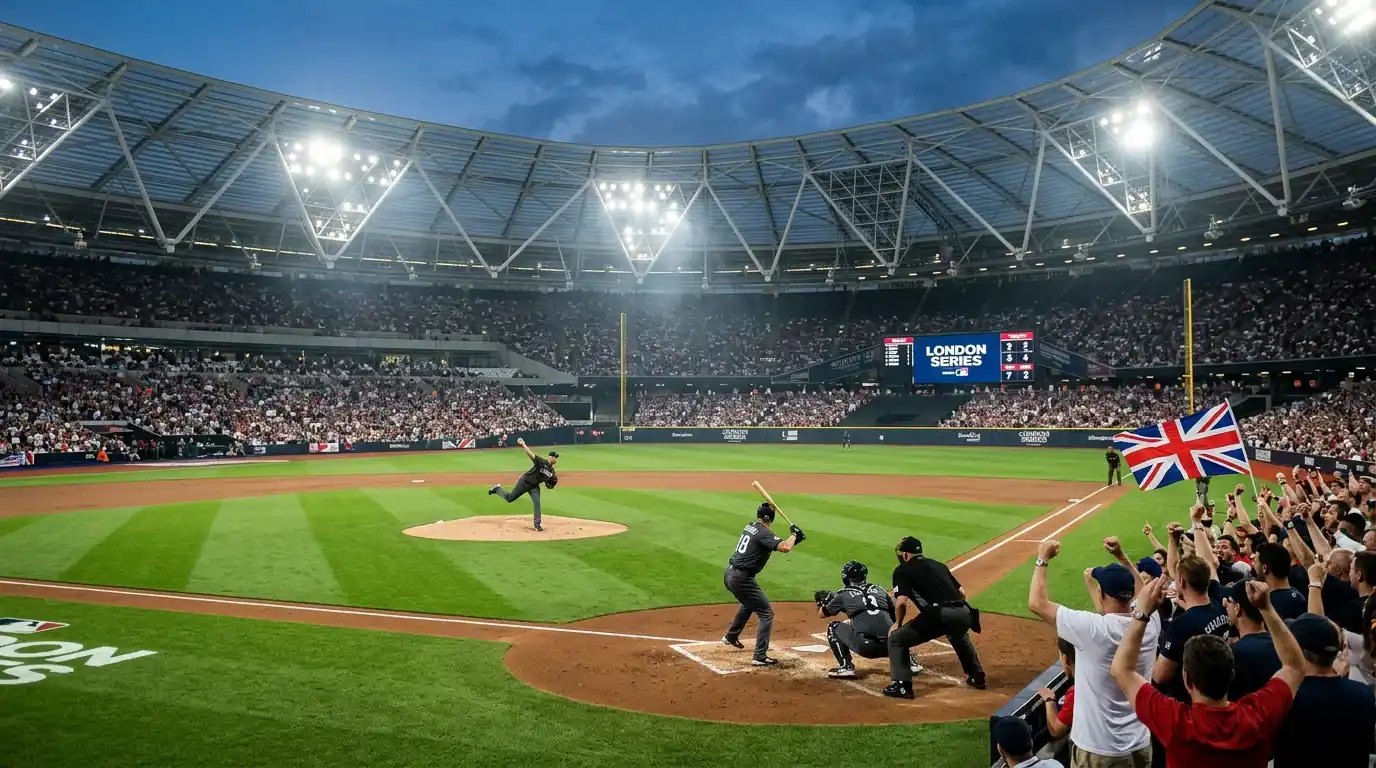
Then something shifted, and I’d put the inflection point somewhere around the 2024 London Series. By the time the Mets and Phillies played at London Stadium that summer, the conversation in the UK industry had quietly changed. The bookmakers I spoke to were no longer treating MLB as a curiosity. Markets were deeper. Limits were higher. Promotions were live. Fractional odds on baseball, which had been an afterthought for two decades, were being properly maintained on Sunday slates by traders who knew what FIP and wOBA meant.
This article is about that shift. Not as a story about MLB’s growth in the UK in the abstract, but as a practical document for British punters trying to make sense of why their bookmakers’ MLB offerings have changed and what to do with the new options. The data tells a clearer story than any opinion I could offer. I’ll let the numbers do most of the work, with my own observations layered around them.
The short version, before the long one: MLB is no longer a fringe UK sport. The audience is real. The economic case for the bookmakers has improved. And the betting markets available to UK punters reflect that, with knock-on effects on prices, liquidity, and prop availability that genuinely matter to anyone betting baseball from Britain.
The £67 million number: economics of the London Series
The single number that did the most to change UK industry attitudes toward MLB was the £67 million economic boost the 2024 London Series generated for London. That’s not a marketing figure pulled from thin air — it’s the estimate produced by the Greater London Authority and Major League Baseball in their joint post-event analysis. To put it in context: that’s a comparable economic footprint to a major Premier League club’s home weekend, generated by two regular-season MLB games over forty-eight hours.
How does a two-game series produce that kind of impact? Hotels filled, restaurants busy, public transport at capacity, retail spend across the West End. Average attendance reached 55,000 per game across the two-game weekend, and roughly 71% of attendees came from the UK rather than the US. That’s the stat that matters most for the betting industry. If London Series attendance had been 80% American tourists, the economic case for the bookmakers would have been thin — those visitors don’t sign up for UK accounts, don’t bet on UK platforms, don’t generate ongoing volume after the weekend ends. A 71% UK attendance figure means a sustained domestic audience.
The Greater London Authority’s involvement here is worth pausing on. The original push to bring MLB to London came in 2017, when the GLA provided a £300,000 grant — roughly $380,000 at the time — to attract Major League Baseball to stage games in London. That seed investment turned into the 2019 inaugural London Series, the 2024 weekend, and a contractual commitment for further series through the back end of the decade. The economic return on the £300,000 has been somewhere in the order of 200x, which goes some way to explaining why other European cities have started actively bidding for similar weekends.
For UK punters, the practical takeaway is that the London Series isn’t a one-off. It’s the visible top of a long-term commercial relationship between MLB and the UK that the bookmakers are factoring into their long-run product investment. The next London Series weekend gets richer markets each cycle. Limits go up. New props appear. The economics that produced £67 million in 2024 produce more in 2026 and beyond, which feeds back into the betting product available to British punters year-round.
How fast is the British MLB audience growing?
Numbers around audience growth get thrown around carelessly in sports marketing. Most of them are vanity metrics that don’t translate to commercial reality. The MLB UK growth figures are an exception in that they’re large enough to be commercially meaningful and specific enough to be verifiable. In the year leading up to the 2024 London Series, MLB UK social media channels grew by 133%, while MLB merchandise sales in Britain rose 43% year-on-year.
A 133% social growth rate is the kind of number that suggests audience acquisition rather than engagement on existing followers. New fans signing up. Casual viewers becoming regulars. The 43% merchandise number is harder to fake — people don’t buy a Yankees cap or a Red Sox jersey unless they’ve made some level of fan commitment, and a 43% jump in a year is consistent with a meaningful expansion of the active fan base rather than just deeper spending by the existing one.
The 2019 inaugural London Series gave us the first real data point on UK demand. The two-game series sold out 120,000 tickets in under an hour. Under an hour. That speed of sell-out told MLB and the bookmakers that there was a sleeping market in Britain that nobody had been pricing properly. Five years later, the 2024 series sold at similar pace and at higher ticket prices, with comparable American attendance share. That’s the kind of repeat market behaviour that turns a one-off into a fixture, both on the calendar and on the betting coupon.
Where this audience growth gets interesting from a betting perspective is in how it changes UK bookmakers’ willingness to invest in their MLB products. A bookmaker pricing a small market keeps a small trading team and runs thin margins; a bookmaker pricing a growing market hires more traders, builds better models, and can afford tighter prices. The 133% social growth is, in part, what made it economic for UK operators to start running competitive MLB lines rather than copying US odds with a margin uplift.
What MLB executives actually say about the UK
I’m generally suspicious of executive quotes in sports marketing — most of them sound like they were written by the same publicity firm and could be applied to any market in any sport. The MLB executive comments about the UK are interesting because they’ve shifted noticeably between 2019 and the most recent press cycle, and that shift tracks the actual commercial reality on the ground.
Chris Marinak, MLB’s Chief Operations and Strategy Officer, was unusually direct in a 2024 interview with the Associated Press. “We’ve clearly identified the U.K. as a priority market and an area that we plan to emphasise for international growth of Major League Baseball.” That’s the kind of language that gets noticed inside the league office, because “priority market” carries budget implications that “important market” doesn’t. When MLB’s strategy office says a country is priority, marketing dollars and broadcast deals follow.
Commissioner Rob Manfred has been more cautious, as commissioners tend to be, but he’s been openly bullish on MLB’s recent attendance trajectory. “The owners feel like we’re off to a great start. We’re up about 1.6% on attendance. We look like we’re headed for our third year in a row of increased attendance,” he told the press at the May 2025 owners’ meetings. The trajectory he was describing turned into a 71.4 million attendance figure for the 2025 season — the third consecutive season above 70 million for the first time since 2015 to 2017. That’s domestic US attendance, but it matters for the UK story because a healthy domestic league makes international expansion economically viable.
Manfred has also signalled that the UK isn’t the end point. At a press conference in Mexico City in April 2026, he said: “We are interested in expansion … if distributors (broadcasters) add up around the world for us, there are other markets for baseball.” Read that carefully. The expansion language is qualified — “if distributors add up” — which means broadcasting deals are the gating factor for further international growth. Paris, Berlin, and Tokyo have all been mentioned in subsequent reporting as candidate cities, and the UK is the model they’re trying to replicate elsewhere. For UK punters, this matters because it confirms that MLB sees the UK product as durable, not transitional.
How UK bookmakers responded: markets, lines, promos
The bookmaker response to MLB’s UK growth has been measured rather than explosive, and that’s a feature rather than a bug. Bookmakers don’t generally launch entire product lines on speculative demand — they expand incrementally as proven volume grows. What’s changed in the last two years isn’t the headline list of MLB markets available to British punters, which has always included moneyline, run line, and totals. What’s changed is the depth and quality underneath.
Two years ago, prop markets on a midweek MLB game were sparse — sometimes three or four player props per game, sometimes none. Today the average UK operator runs ten to fifteen prop markets per game on a regular slate, with some operators going deeper on weekend games. That’s still narrower than the US average, but it’s a meaningful expansion. The same applies to alternate run lines and alternate totals, which used to be available only on flagship games and now appear on most regular-season games.
Pricing has tightened in tandem. The juice on standard MLB game lines at UK bookmakers used to lag US pricing by 1-2% on average — a ten-cent moneyline at a US sportsbook would be a 12-cent or 14-cent line at a UK book. That gap has compressed to roughly 0-1% on the better UK operators, and on London Series weekends specifically, several UK books actually post tighter prices than the US average. That isn’t a permanent state — UK liquidity is still smaller than US liquidity, and the prices reflect that on a yearly average — but on focused weekends with concentrated UK volume, the pricing competition is fierce.
Promotions have followed the same path. MLB-specific promos used to appear only around the World Series and London Series. Today the larger UK operators run weekly MLB promotions throughout the regular season, ranging from boosted runlines on flagship matchups to strikeout-prop specials on featured starters. The promotional terms still vary widely between operators, and the value of the promotions varies even more widely, so the discipline of reading the small print and shopping multiple sites remains the same. But the headline volume of MLB-specific promotions has roughly tripled in two years, which is itself a market signal.
For UK punters this is mostly good news, with one caveat. As bookmakers compete more aggressively on MLB markets, the soft prices that used to exist on UK MLB lines have started to disappear. Three years ago, a moderately-skilled UK punter could find pricing inefficiencies on Sunday morning MLB lines that wouldn’t have existed on equivalent US baseball markets. Those inefficiencies have largely been closed. The market is more competitive, which is great for fairness but harder for finding edge. The frontier has moved from “exploit lazy UK pricing” to “exploit market-specific edges that the global market hasn’t fully integrated”, which is a harder game.
Worth saying clearly: every operator I’m describing here is operating under the UK Gambling Commission’s licensing regime, which structures what they can and can’t do — from advertising rules to promotional terms to consumer protections. That regulatory backbone is what makes UK MLB betting fundamentally different from offshore equivalents, and if you want to understand how the rules shape the products you’re using, the broader picture lives in how UK gambling regulation applies to MLB betting.
Watching MLB legally in the UK
The single biggest barrier to MLB betting in the UK isn’t access to bookmakers. It’s access to the games themselves. You can’t reliably bet a sport you can’t watch, and the MLB broadcast situation in Britain has been historically patchy enough to deter casual interest. That, more than anything else, is what’s been changing.
MLB.TV, the league’s direct-to-consumer streaming service, is available to UK subscribers and broadcasts the entire 162-game regular season plus the postseason. UK access has no in-market blackouts (unlike the US version, which has heavy local-market blackouts), so a UK subscriber gets every game live, every day. The growth in MLB.TV consumption globally has been remarkable: MLB.TV recorded 19.39 billion minutes of viewing in 2025, up 34% versus 2024 and a new consumption record. The UK is a meaningful slice of that growth, and the trajectory implies that streaming-first MLB consumption is now a mainstream UK consumer behaviour rather than a niche.
The structural change in 2025 that helped UK adoption was MLB’s pace-of-play work. Average MLB game time was 2 hours 38 minutes in 2025 — the third consecutive season at or below 2:40, the first such streak in 40 years. That’s transformative for UK viewers because a 1am first pitch finishing at 4:38am is a different proposition from one finishing at 5:20am. You can plausibly watch the first six innings of a key 7pm Eastern game from your sofa, then check the box score in the morning. Two-and-a-half hour games make MLB compatible with normal UK adult life in a way that 3:30 baseball never was. To put a finer point on it: only three nine-inning MLB games in 2025 lasted 3:30 or longer, compared with 391 such games in 2021. That’s not a marginal change. That’s the sport reshaping itself.
Beyond MLB.TV, UK terrestrial coverage has expanded modestly. Sky Sports and BT Sport have rotated some MLB content; the BBC has shown highlights on iPlayer; ITV broadcast portions of the London Series. None of those is a substitute for MLB.TV for serious betting, but they help build broader awareness and casual engagement, which translates to deeper bookmaker investment over time.
The European understanding gap
One of the more honest comments I’ve come across about MLB’s European prospects came from Boris Helleu, a senior lecturer in sports marketing at the University of Caen Normandy. Speaking to the AP around the 2024 London Series, he said: “For Europeans, for instance, the rules are quite difficult. (American football and basketball) are easier to understand and maybe more spectacular.” That’s a real obstacle. The rules of baseball are not intuitive to someone who grew up on football, and the rate of casual conversion is genuinely lower than it is for the NBA or the NFL.
What’s interesting is how baseball compensates for this. Football is the world’s most popular sport in part because it requires almost no explanation. Cricket, the closest sporting cousin to baseball in many respects, is enormously popular in former Commonwealth countries despite being even more rules-heavy than MLB. The path from cricket fan to baseball fan turns out to be much shorter than the path from football fan, and a meaningful slice of the UK MLB audience growth has come from cricket fans crossing over rather than football fans converting.
From a betting perspective, the rules complexity is actually an advantage rather than a barrier. Bettors who understand the sport’s mechanics — pitcher matchups, ballpark factors, batter splits — have a wider edge over casual punters in baseball than in football, simply because the sport has more interlocking inputs that reward study. The flip side is that casual UK punters who don’t take the time to learn the basics are at a structural disadvantage that they don’t have when betting on Premier League football. The market knows this and prices accordingly: MLB juice is generally tighter at UK books than equivalent low-information markets, which means the bar for profitable casual betting is higher.
The understanding gap also affects which markets attract UK volume. Moneyline and totals see most of the UK action because they’re the most intuitive — pick a winner, predict the scoring level. Run lines, props, and futures see proportionally less UK volume than US volume, partly because they require a deeper understanding of the sport to evaluate properly. That distribution of volume is itself a betting signal: the markets with thinner UK volume are more likely to contain mispricing relative to their US-pricing counterparts, because there are fewer UK punters putting competitive pressure on them.
The London weekend context for UK bettors
For UK bettors, the London Series weekend is a slightly different beast than a regular MLB Sunday. The market dynamics shift in specific ways that are worth understanding before you bet on those games — even though the actual tactical angles are a deeper topic I cover separately. The headline change is that UK volume on London Series games is concentrated and asymmetric in a way it isn’t on standard slate games.
Concentrated, because UK punters who don’t normally bet MLB regularly do bet the London Series. The novelty of the matchup, the convenience of a UK kick-off time (typically afternoon or evening rather than 1am), and the surrounding promotional activity bring in casual money that doesn’t exist on a typical Tuesday slate. That extra volume affects pricing — favourites tend to get a price boost from public money loading on them, and totals can drift upward as the weekend approaches because of casual over-betting.
Asymmetric, because the public money is heavily skewed toward whichever team has the bigger UK fan base, which tends to be the more famous franchise rather than the better-pricing one. If you bet against the public on London Series games, you’re betting in the same direction as US sharp money in many cases, which is a friendly position to be in. The exception is when one of the teams has a particularly loud UK presence — Yankees games at the London Series, for example, see public money so heavy on the Yankees that fading them often becomes a +EV play purely from the line distortion.
The other weekend-specific element is bookmaker promotional activity. Most UK operators run enhanced promotions on London Series games — boosted prices, free bets, no-juice specials — that don’t exist on standard slate games. The headline value of these promotions is real but variable. Read the terms. Many of them have stake caps, market restrictions, or specific qualification structures that limit their actual EV. The promotions that turn out to be most valuable in practice tend to be the ones with the least flashy advertising — boosted alternate runlines, enhanced totals — rather than the loudest “free bet” offers, which often have the most restrictive conditions.
What comes next: Paris, Berlin, Tokyo?
The trajectory MLB is on suggests the UK is the proof of concept rather than the destination. Manfred’s “if distributors add up” framing is the closest thing the league has to a public roadmap, and the cities being mentioned in subsequent reporting all share certain features: large metropolitan populations, established sports infrastructure, viable broadcast partners, and existing baseball communities. Paris (where the European baseball calendar already has roots), Berlin, Tokyo (which already has a 50-year MLB exhibition tradition), and possibly Mexico City as a Spanish-language anchor.
For UK punters, the question is whether further European expansion changes the UK product. My read is that it both helps and complicates. It helps because more European games — at European-friendly times, with European-resonant matchups — give UK bookmakers more material to work with and more reason to invest in deeper MLB markets. It complicates because the UK loses some of its current “priority market” exclusivity if Paris and Berlin start hosting their own series, and the bookmaker investment that’s currently flowing toward London Series specifically may be diluted across multiple European venues.
The other complicating factor is broadcast economics. The current MLB.TV economics work in part because the global subscriber base subsidises smaller markets. As MLB expands its broadcast footprint into multiple European countries, the local broadcast deals for individual markets — including the UK — become more commercially relevant. That’s likely to produce richer terrestrial coverage in the UK over time, which feeds the audience growth flywheel that the bookmakers respond to.
What I’d actually expect over the next three to five years is roughly continuous improvement in the UK MLB product, with occasional accelerations around London Series weekends and broader European events. The bookmakers will keep tightening prices, deepening prop menus, and matching US-equivalent product features one by one. The UK punter who’s been on the edges of MLB betting for years will find the experience getting steadily more sophisticated. None of that is dramatic. It’s the slow compounding of a market that’s now too economically real to be ignored.
When is the next MLB London Series?
MLB has an ongoing commitment to stage regular-season games in London on a roughly biennial cadence following the 2019 and 2024 series. Specific dates and team matchups for upcoming series are announced by MLB and the Greater London Authority typically several months in advance, so the most reliable source is MLB’s official calendar updates rather than any single year’s reporting.
Where can I legally watch MLB in the UK in 2026?
MLB.TV, the league’s direct-to-consumer streaming service, broadcasts every regular-season and postseason game to UK subscribers without local blackouts. UK terrestrial channels including Sky Sports, BT Sport, and ITV occasionally carry select games and event weekends, but MLB.TV remains the only comprehensive way to follow the full season from Britain.
Do UK bookmakers offer the same MLB markets as US sportsbooks?
The headline markets — moneyline, run line, totals — are present at all UK bookmakers and broadly match US offerings. The depth underneath is narrower: UK player prop menus typically run ten to fifteen markets per game versus thirty to forty at US sportsbooks. Alternate run lines, alternate totals, and futures markets are well-covered at the larger UK operators, particularly around London Series weekends.
How do I bet on MLB London Series games specifically?
London Series games appear on every UK operator’s coupon during the weekend they’re played, typically with enhanced market depth and a higher density of promotions than standard slate games. The pricing tends to skew toward whichever team has the bigger UK fan presence due to concentrated public money, which means the value side is often the team being underbacked by British casual punters.
Published by the how do you bet Baseball team.